Well its been a while since I've posted anything on here. I've spent much of the past two months following the stock market more closely and trying to learn how to trade it, so I haven't focused much on currencies. Starting fresh for 2012, I've tweaked my currency strategy a little bit. I'll be looking for some more longer term swing trades (not much longer than a week maximum though). I'm going to be focusing on only about four majors (EUR/USD, GBP/USD, AUD/USD, USD/CHF) because I think it will help me better learn these pairs and gain an edge. My position sizing will be small, with much more focus on trading correctly than making money. I'm planning on doing a weekend analysis each week of what I will be looking at for the next five trading days (Under the Weekend Outlook tab!)
I think that stepping back the timeframes I trade on will help me gain a broader sense of how everything is moving, rather than scraping up pips intraday. I'll be much busier with school this semester, but I'm hoping to get at least 2-3 posts a month done on top of the weekly analysis. Good luck to everyone this week and this year.
Sunday, January 8, 2012


Saturday, November 5, 2011
Trading the USD/CAD by Jon Hewson
My name is Jonathan Hewson and I am a sophomore finance major at the University of Pittsburgh. I am a member of @thetradingpitt with Jake and I will be writing a few blogs about my trading to go along with his. I am mostly a day/swing trader but I wouldn’t say I have exactly found my nitch yet.
I have been working extremely hard this semester to put together a trading plan that will work logistically with all my classes while maintaining a consistent profit margin. I find it difficult sometimes to get the right intraday entry and exit points when I am only in my room at night, during the least traded hours of the day. I use a lot of indicators but one of my favorites is Pivot points (daily, weekly and monthly). These can be extremely powerful support and resistance levels but they require you to judge breakouts and bounces very efficiently. The trade that I am least successful with over the course of my career is definitely the breakout trade. I always seem to buy the highs, sell the lows and the breakouts never pan out the way I want.
One reason I see for this is my innate desire as a trader to get the best price possible. There have been too many times when I buy or sell within four or five pips of a certain level and see price immediately shoot off the opposite direction. One example of this was with USD/CAD this week (10/30/2011). Price had worked its way up to the monthly pivot point (calculated at 1.018) during the first few days of November. I wanted to enter a trade at the break/bounce of this level because I saw a lot of $USD price action in the coming weeks. I saw price break the level and retest on the 15 minute charts so I bought at the white arrow seen in the picture (around 1.01890). As you can see price moved against me, eventually hitting my tight stop at 1.0149. Soon after my stop was triggered I decided to go short, thinking that price had rejected a move above the monthly pivot level. However, price again moved against me, passed the 1.018 level and my stop was again triggered. Two losing trades in a row.

Seeing the charts now, my decisions seem incredibly stupid. The movements of the market weren’t nearly strong enough to warrant a break. So, where to go from here? I am writing this blog partly just to hammer into my own head that following the trend is far more profitable then attempting to get a perfect entry. In the future I am going to look at longer timeframes, BE PATIENT and WAIT for price to show a clear sentiment in a certain direction.
Thursday, November 3, 2011
ORCL 11/3
Today I'm going to give a quick rundown of my first trades in the stock market. As of now, I'm still playing around with different ideas and strategies, but I figured I would jump right in and go from there.
I decided to trade Oracle today. Its a name I'm somewhat familiar with, not too expensive, large cap, and liquid. I like tech in general because its relevant to me. Oracle has been stronger than the market since about mid August, although I didn't really recognize this until after my trades. Below are daily charts of $ORCL (top) and the $SPY (bottom).
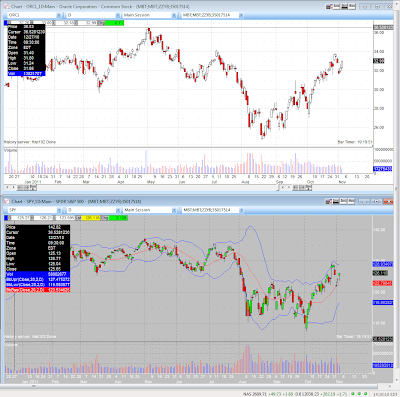

I decided to trade Oracle today. Its a name I'm somewhat familiar with, not too expensive, large cap, and liquid. I like tech in general because its relevant to me. Oracle has been stronger than the market since about mid August, although I didn't really recognize this until after my trades. Below are daily charts of $ORCL (top) and the $SPY (bottom).

I started off looking at the one minute charts a little bit after 12 noon. It looked to me that the SPYs might be stuck under the 125.30 level that had held resistance a number of times earlier in the morning. Thinking it might fall back into the day's range, I shorted at 32.62 when it failed to break the falling trend line shown in the picture below. My stop was at 32.72, and after shortly moving it my favor I was stopped out. This should have tipped me off that both the market and $ORCL were stronger than I had expected. Unfortunately it didn't and I tried to get short again near 1pm at 32.70. This was a bad mistake, getting short a strong stock in a rather strong market (in addition, the SPYs had just made a new high). Had I analyzed a longer timeframe I would have seen this. @stevemcmannis let me know of my mistake and I was stopped out soon after. $ORCL trended up all day, along with the market .

1 min ORCL (top) & SPY (bottom)
I learned that I need to be more aware of relative strength intraday. I also need to think more about the time horizon for my trades. My first trade moved for me immediately like I thought it would, but once the SPY's showed they weren't going to break down further I should have gotten out. I'll be back at it tomorrow, following $ORCL and hopefully a few more. Good luck, and have a great weekend.
Tuesday, November 1, 2011
Beating Markets Update and Changes
Hey all. Its been a while since I've posted anything on here (been spread really thin with school, growing our university trading club, my own trading), but I'm making it a top priority to keep up with the blog from now on. I recently spoke with another good young trader from Pitt named Jon Hewson (@Hew_Dat) who is going to be hopping on board and helping me run Beating Markets. He is a forex swing trader and is also involved with equity options, so he'll be bringing a slightly different perspective to the blog.
Also, my interest in the stock market has been increasing a lot lately, so I just opened up a demo account and will be trading equities. Right now I plan to focus on swing trading while occasionally trading intraday with in-play stocks to see which method suits me best. I've always followed the stock markets with my forex trading but I've never focused on individual names, and I'm excited to jump right in. I plan on being as transparent as possible on Twitter and will hopefully be posting at least 1 or 2 trade reviews/videos a week on here.
I'm pretty excited about these changes to the blog. I'm expecting this blog to be much more active than it has been the past few months, and I think it will be great to discuss the stock market as well as forex in our posts. Keep an eye out for new posts in the next week or two and good luck with your trading!
Wednesday, September 14, 2011
Beating Markets, Fall 2011
I've been thinking a lot about new ways to upgrade the blog, making it a little bit more helpful for everyone who checks it out as well as for myself. I've thought of two main ways of accomplishing this, with Chart of the Day/Week and videos reviewing my trades and short term market outlooks. A detailed trading log has also been in my considerations so that I can be ultra transparent.
Within the next few days, I hope to start implementing these upgrades as regularly as possible. Any suggestions for additional ideas would be sweet too; I'm open to just about anything.
Happy Trading to all!
Within the next few days, I hope to start implementing these upgrades as regularly as possible. Any suggestions for additional ideas would be sweet too; I'm open to just about anything.
Happy Trading to all!
Tuesday, September 6, 2011
CHF Devaluation
This morning, the Swiss National Bank took extreme measures to rapidly and powerfully devalue their currency. The SNB has announced a formal base price for the franc vs the euro at 1.20. They have said they will defend this level with "utmost determination" and that they are willing to buy unlimited amounts of foreign currency. This is an unprecedented move by the SNB and is certainly the most drastic and acute central bank intervention I've ever seen.
First, lets think about why this intervention happened for those who haven't been following this currency. The ongoing economic issues in the euro zone and in American have caused investors to seek a save haven from risk in the Swiss franc. This has caused the USD/CHF to move from 1.00 in Dec. '10 to this year's low of 0.7066, and has caused the EUR/CHF to move down from this years high of 1.3240 all the way down to 1.0067 (the pair was also above the 1.50 mark back towards the end of 2009, so this downtrend has been quite long term). This puts deflationary pressure on the Swiss economy. The Swiss economy is highly dependent on exports (they make up about 50% of the nation's GDP), and a strong currency chokes out the profits of exporters. In general, things cost more for the Swiss people, and the rate at which their currency has rose in the short term is unhealthy for the Swiss economy.
Second, lets think about how this will affect us as traders in the short and medium term. If the SNB keeps their word, the 1.20 level will act as a stiff bottom to play off of and a great spot for large and small investors to get long at. In reality, 1.20 is still much lower than we were even 2 years ago, so don't think this level will be attacked in the short term. No one outside the SNB really knows how long this level will be defended, but some are saying that it may last only up until the October 23 elections. Nonetheless, this drastic intervention has structurally changed the CHF's outlook. We've gotten above long-term resistance at 0.8550 in the USD/CHF, so we could start to see some bids in this pair in the short term. I'm still seeing a 50% fib level on the daily's at about 0.8565 that has held today, so we'll see how the markets react to that level for the rest of today and into tomorrow.

There's no need to rush into any franc trades today. There will be plenty of opportunities that will present themselves in the next few days as new short term levels are carved out. I want the market to determine some intraday price levels that I can reference before I start playing off this currency. I definitely have a long bias right now (I'm in no position to trade against a central bank), but I'm curious to see how this will play out in the midterm. The Swiss economy is still much better than that of the US and Eurozone, so from a fundamental standpoint, buying francs is still a good play. The SNB will also have to decide what to do with all the excess euro's they are buying to maintain this rate. I doubt this will be my only post about this event, but that's all I have for now. Good luck trading, wait for good opportunities, and keep your risk covered (I realllllllly hope no one was long francs without a stop last night; I can imagine how shitty it would have felt to be woken up by a margin call this morning).
Tuesday, August 30, 2011
Back at it USD/CHF 8-29-11
Well now that work is done and school's starting, I'm back into trading during the day. Just paper trading this week to ease back in and feel out the markets, but I figured I'd review a trade I made this morning.

The dollar franc made my watch list last night because yesterday it had wicked above the 38.2% fib retracement from December '10 til early August. We were also near resistance at ~0.8275 and a little bit further out the 100 day MA. I figured with all this resistance on the horizion, there may be some good selling opportunities in the morning.
This morning I saw that the pair was nearing yesterday's high at 0.8240. We began to consolidate just under this resistance around 0.8230 and I decided to get short targeting 0.8187 w/ stop above yesterdays high. Caught a nice down move from there and I sold more at ~0.8212. Resistance at 0.8205 held solid and we saw a nice bounce from there, so I manually closed half of my position and eventually was stopped out at 0.8217 for +8 pips.
I was pretty satisfied with this play for it being my first day back. One of my goals for this fall is to improve on adding to my positions. I think I did a good job of this today. One mistake I made this morning was rushing my trade a little bit. I didn't notice the resistance at 0.8205, and that would have changed my whole plan for the trade. There was also a little uptrend that was carved out on the 5 min chart that I missed. Had I seen this I would have seen that 0.8205 was a perfect spot to target for a quick trade like I was making. I think it will still make it to 0.8187, but it won't happen the way I saw it playing out.

I'm probably going to just watch the rest of the morning and get a feel for how everything is trading. US Consumer Confidence will be out in about an hour, so heads up for that. I'm hoping to be blogging at least one trade review everyday, so keep an eye out for those. Good luck and happy trading.
Friday, August 12, 2011
A Little Psychology...
Well, it’s been a while since my last post (been busy with repairing the shack I called home this past year, moving out, working on stuff for the Trading Pitt, etc.) but I decided now is a pretty good time to think about where our head needs to be at as traders, especially in markets that have been as wild as the ones the world’s been experiencing lately.
I’ve spent a good chunk of today reading Andrew Menaker’s blog (which can be found at http://www.andrewmenaker.com/ideas/blog/), and he always offers great self-evaluation ideas and food for thought. One of his latest post talks about the need to be right. This need is kryptonite to a trader. The feeling of being correct is almost like a high for some people, and they constantly need to feel it. Problem is, most of the best traders aren’t even correct half the time. So to be successful, it’s absolutely essential we can deal with being wrong and don’t let our predictions dictate whether or not we are profitable.
Think about everything that’s been going on in the markets lately. The nauseating roller coaster we’ve been on has opened the door for everybody to provide their opinion on what will happen next. Many have been wrong, some have been right, some haven’t had a clue what’s been going on. This is exactly the type of situation where we all need to be flexible as traders. Use of if/then statements is absolutely key. Sure, you always want to do a thorough analysis that provides you with a good idea of where the market might go but you need to have a Plan B if it doesn't go as planned. As Menaker says, there is "a subtle but critical difference between anticipation and prediction." Traders who anticipated moves but ultimately took what the market gave them profited during the past two weeks; traders who made unwavering predictions got sauced.
Another great little post from Menaker's blog talked about trading the market or your P/L. Its been said a million times but tons of traders, especially beginners, still struggle with it. We CANNOT trade worrying about how much money you make or lose. I'm still working on this concept myself. I can't tell you why, but most of us (especially beginners) trade differently when we know we've lost money or are losing money. The best way I've learned to deal with this is to completely remove your P/L from the screen. Obviously, we still need to respect daily stop out and tolerance limits, but hiding your P/L allows you to concentrate more on price action and objectively make and manage our trades. Try it if you don't believe me, I can guarantee that you will feel a lot more relaxed and confident when your not worried about your account.
School will be starting up for me in about two weeks, so I'll be back to trading live during the days. I hope to start doing a chart of the day and posting video reviews of my trades as often as possible. I hope everyone has a great, relaxing weekend!
Friday, July 8, 2011
FX Outlook for 7/8/11: Pre NFP
I'm expecting tomorrow to be the biggest trading day of this week, notably because of US employment and payroll data. CAD also has some important employment data, so there should be some fireworks early on tomorrow morning in all markets.
Last time the NFP came out in May we saw very disappointing results (added 54k with expectations of 170k, unemployment rose to 9.1%). Afterwards, just about everyone sold dollars for the rest of the day. This time around, were expecting an increase of at least 100k with some expecting the number to be as high as +175k. Since there has been a string of good US data lately on top of recent strength in the US markets, I believe the markets have already accounted for these payroll and unemployment figures, so in order for the data to be bullish for the dollar they must come in significantly higher than expectations. Sure, we will probably see a nice pop even if they are in line with expectations, but it may not carry through the day. On the other hand if we see data well below expectations, I'm expecting a hard dollar selloff. The SPY and IWM are both near significant resistance and have just seen strong runs in the past two weeks. There could definitely be some panic selling in US markets if bad numbers come in. I have a hard time seeing either the SPY or IWM moving through resistance unless we see some extremely good numbers, but I'm not expecting it. The dollar index, which is still in a very long term downtrend, looks to be flattening out a bit and showing a little bit of strength.
Some predictions for dollar-denominated pairs:
The EURUSD has been consolidating on the daily's for some time now, and off line data could set us off in one direction or the other. The euro has been struggling to stay afloat as the ECB raised key interest rates and Portugal received a downgrade earlier this week. If the numbers come in at expected or higher, I think we’ll definitely start selling off. The next support looks to be around 1.4140, so that could be a good initial target.
The AUDUSD has moved higher in the past two weeks due to US market strength and investors seeking higher yields. If dollar strength continues, this move higher could very well continue. We’ll definitely be running into some traffic on the upside though, so keep that in mind. If data comes in weak, there are at least 100 pips of possible downside that we could see today, depending on how much we come up short. Short-term downside support looks to be around 1.0725, then 1.0680, then 1.0650.
Another pair I’d be interested in in the long term if we see good US data is the USDCHF. This pair has been trending down forever and while it hasn’t quite broken out of the downtrend yet, it may have found some support near 0.8325. This is a very well-defined and obvious trend that people will be looking at, so I think there is nice upside potential if we can break out. Strong NFP numbers may be a perfect catalyst for this to occur.
All of the dollar denominated pairs will be in play this morning; these are just a few I will be following a little bit more closely. I always try to avoid any exposure before huge data like this, and I like to wait 15-20 minutes at least to let any type of kneejerk play out. Don’t chase moves you’ve missed, just be patient and wait for pullbacks. And finally, remember to listen to the market and take what it gives you! Be flexible, because it’s easy to get burned if you’re stuck on a particular idea. Any questions, please feel free to ask. Happy Trading!
Sunday, July 3, 2011
FX Outlook 7/4-7/8
Alright, after a little camping trip last week I'm back from hiatus and ready to trade this upcoming week. Since Monday is Independence Day here in the States, I'm expecting volume to be lighter across the board. The US equity markets showed a very strong rally last week, but most of it was on lower volume and we're now entering the resistance area near this year's high's between 135 and 137 in the SPYs. I'm not expecting a ton of movement in the US markets ahead of Friday's NFP data, but I think those numbers will be very important for the markets in the coming months.
EUR/USD
The euro gained on the dollar last week and appears to be out of immediate danger since Greek austerity measures were passed and are in good position to receive approval from the IMF for their next tranche of bailout money. We look to be consolidating a little bit on the daily chart, and I expect most people will be trading the news this week. As QE2 comes to an end & the Eurozone is pulling itself together at least in the short term, the dollar needs some strong numbers this week or it may continue to slide.
GBP/USD
The dollar also gave some ground to the pound last week, but the pair is still in a downtrend that's looking a little bit steep on the daily's. Again, I think the beginning of the week may be a little bit slow but the BoE rate decision and NFP's at the end of the week should be a catalyst for movement. I think we'll continue to move downwards in the short term mainly on pound weakness rather than dollar strength.
AUD/USD
Greek austerity has helped the aussie dollar a lot in the past week as many people's appetite for risk has returned. Another strong week could put it up near yearly high's against the dollar, and we're still in a long term uptrend dating back to about a year. This week we'll be seeing a RBA rate decision and employment data, both of which need to come out at or above expectations to keep this short term upmove going. Anything under expected could lead to a bullish outlook for the aussie.
USD/CHF
This pair has been downtrending forever now, but we may have put in a little double bottom 0.8315. I'm expecting to consolidate between this level and the downtrend line, but the mid-term outlook might hinge on this Friday's NFP's. Also, look for some minor swiss data this week that may cause some movement, but Friday's numbers will be the most important.
That's probably all I'll really follow this week, maybe the NZD/USD as well since the kiwi has GDP numbers coming. As always, the market's opinion is much more important than my opinion. Trade what the market gives you, not what you think the market should do. Hopefully I'll trade a little better than I played golf today (lets just say I definitely got my money's worth with how many swings I took), and I'm hoping to get one more post up this week at least. Have a good holiday if your in the US, and good trading to everyone this week!
Sunday, June 19, 2011
Embracing Failure
"I've missed more than 9,000 shots in my career. I've lost almost 300 games. Twenty-six times I've been trusted to take the game winning shot, and missed. I've failed over, and over, and over again in my life; that is why I succeed."
-Michael Jordan
Michael Jordan is the best basketball player ever (go ahead and try to argue that if you disagree). When you look past his 6 championship trophies with the Bulls along with countless MVP awards, scoring championships, and other accolades, you see that he was cut from his varsity team in high school and how he came up short of a title in each of his first 7 professional seasons. Michael Jordan became the best because he faced a lot of failure throughout his career. If you look through the history books, you'll see that just about any highly successful person has failed on their way to the top.
As traders, we face failure more often than most people. If you trade intraday, I'm willing to bet within the past week or two you've had at least one day where your timing was just a little bit off or your setups just didn’t work out like they normally do. While it’s easy to get frustrated and down on ourselves, we should really be thankful for the days of failure the market gives to us.
If we are going to be consistently profitable traders, we need to learn to cope with failure as well as make the most of our failures. Humans are naturally inclined to be more sensitive to failure than success. In order to cope with failure, we first need to accept that EVERYONE faces tough times; we’re not alone in out struggles. The faster we realize that some degree of failure is unavoidable, the better we will be able to accept it when that time comes. Another way to cope with failure is to keep a level head when you’re losing as well as when you’re winning. Don’t get to high on yourself when your winning, and don’t get too down when you lose. Just move onto the next trade and focus on performing the best you can. Many of us will make hundreds or thousands of trades in the long run, so a handful of losses may seem unbearable in the short term but means virtually nothing in the long run. When you’re struggling, reach out to other traders and just talk to them. Chances are they’ve been in the same position before (or worse). They made it through, and so can you. Every trader loses sometimes, but our main goal must be to live to trade another day. If we lose all the money in our accounts, then we physically can’t trade. Cutting position size, following strict stop out rules, and not trading frustrated or forcefully are great ways to minimize your losses and ride out the tough periods. If you can’t be in the right state of mind when you’re trading, it’s best to just step away and not trade until you get your head straight.
There are plenty of ways to capitalize on your failures and make yourself better in the process. Filming your screen and reviewing certain situations that you struggle with is one great way to do this. Things seem to move slower the second or third time around, so you can really focus on where you made your mistakes and why they happened (This has become my favorite method of reviewing my trades; its great!). The next time a similar situation arises, you’ll be able to remember back to your past experience to avoid the same mistake this time around. Document all your trades on paper, too. Be detailed, and be brutally honestly with yourself. If you did something stupid, writing it down helps you take full accountability for it. Another great way to improve on your failures is visualization. Put yourself back into the situation that caused the failure. Remember the thought process you were using when you made your decisions and correct yourself where you were wrong.
Bottom line, failure is unavoidable. I’ve been reading the Market Wizards books this summer, and nearly every single one of the world’s best traders have had periods of failure. They didn’t allow these times to ruin them; instead they turned them around and used them as learning experiences. If we do the same, we will only be setting ourselves up for future success. Have a great rest of the weekend, Happy Father’s Day, and best of luck in the upcoming week!
Wednesday, June 8, 2011
EURUSD 6-8-11
I haven't been trading too much lately, been working on an algo and studying for tests. Tonight I briefly placed a couple trades in the EUR/USD. I typically play ranges during the evenings, so I initially identified 1.4600 and 1.4567 as range levels. 1.4600 was tested twice but 1.4590 wouldn't drop support.
Pair soon after broke 1.4600 convincingly then found support at the level. I like this play during the day, and I've found it usually also works in Tokyo, so I got long @1.4603 with stop at 1.4596. Covered half above session high at 1.4609, moved stop to break even and let the rest ride moving my stop as pair moved up. The move started looking steep and it couldn't hold above 1.4625, so I got flat.

Unfortunately I accidentally made this trade on a demo account. Took a quick, stupid frustration long above the 1.4625 level and was quickly stopped out for a small loss. Other than that, I was pleased with this evening. I have trouble letting my winners run, but I was pretty patient on this play. I'll be looking for this move more often during this session. Its easier than range trading and its fairly low risk.
Thursday, June 2, 2011
Trading an Economic Report
Since plenty of traders including myself look for spots of increased volatility to make a quick move, I figured I’d put together a post about to set yourself up for a successful trade after an economic event or report. On the eve of the May NFP’s, it seems appropriate.
In my opinion one of the most important things to gauge before an event is the expectation of the markets. Just about anywhere you find an event calendar, you can find a value economists have determined to be the ‘expected’ result of an event. Tomorrows NFP number has had a general expectation of +170k, but many have already agreed that there’s a good chance the report will come in much lower than that. Many estimates have already been updated to reflect a lower expectation since this week’s poor ADP numbers (probably closer to +125k or less), and the market has been processing these expectations. Now let’s say that the actual number comes in around +100k. While this is much less than the originally anticipate +170k, you might not see the reaction you’d expect when a number as important as the NFP’s comes in that much lower than expectations. This is because the market has already accounted for much of the difference. By understanding the true market expectations, you can prevent yourself from getting on the wrong side of a freight train.
Another thing that’s almost guaranteed to rip you up is trying to anticipate the market’s reaction and get in before the event. This is basically gambling in my opinion, unless you have some sort of strategy for doing it. Even if a report comes out exactly how you expect it to, the market doesn’t always act accordingly. It’s much safer to let the initial kneejerk pass before trading. Even if you miss the initial move, there usually are plenty of opportunities to safely enter and profit.
Understanding the event is another key to success. Different events often have different types of reactions for different pairs. Some events cause pairs to take off within seconds of the release and never look back, while others take 10-15 minutes to really pick a direction. For example, the most important part of the RBA minutes is the last sentence, so you might not see a real reaction until the report is fully read. Also know what pairs will be in play after a report. You probably won’t see as much volatility trading a yen cross when the BoE announces new rates.
Identify your key levels before hand, prepare for all possible scenarios, and understand overall market sentiment. Be patient and get good entries, but don’t be hesitant or you will get left behind. There is plenty of quick money to be made trading off events, so you have to know how to take advantage of them.
Below is a 5 minute chart showing how the EUR/USD reacted to the April NFP's that came out last month. HUGE move. I'm pretty excited to see what happens tomorrow morning. Good luck to everyone trading it!
 |
| EUR/USD, 5 min, 5-6-2011 |
Wednesday, June 1, 2011
EURUSD 6-1-11
Tonight I saw a good opportunity on the short side in the EUR/USD. It fit my strategy well and gave me about a 4-to-1 reward to risk ratio. I saw a significant past resistance level at around 1.4345-1.4350, so I started offering at 1.4345. The snail pace of Tokyo gets me antsy sometimes, and I didn't want to miss a fill. I started inching down my offer until 1.4343. That order filled but kept pushing up to the whole number 1.4350. Got stopped out but started shorting immediately. Got refilled at 1.4152 and targeted the middle of the range near 1.4330. Unfortunately I accidentally sold on market because a platform mistake at 1.4339 before it knifed a little further to 1.4325. I foolishly tried to get small and hop back in the move, but it was too late and I was stopped out a small amount from the last trade. All in all I maybe about 2 pips on a move that should've gotten me much more.

Had I waited for a good first entry and avoided trading on frustration on the last trade, this would have been a profitable trade even with the order entry error. Need to work on these things for next time. Currently the pair may be about to breakup for a nice little move after pushing through the 1.4350 and holding the retest. That's all for me tonight, happy trading.

Friday, May 27, 2011
The Future of the Euro
Anyone who follows the markets is well aware of the ongoing sovereign debt crisis in Greece. Even after receiving 110 billion euros in bailout money to buy time for new austerity measures to kick in last year, Greece is still in no position to privately raise enough money to cover their debts. Taxpayer protests are becoming more frequent, their debt continues to receive downgrades, and major restructuring looms on the horizon. With the problem become more serious every day, it’s about time we started to think a few months down the road about whether or not the euro will remain as Greece’s currency. Or if it will even exist at all.
Sure, it would take a hell of a lot for the euro to vanish completely in the next few months, but the idea of Greece dropping the currency isn’t that farfetched. After extensive measures have already been taken to eliminate their deficit, the Eurozone leaders are beginning to run out of options. Foreign investment has already come to a standstill. This is undoubtedly the worst off the euro has been in its short history. Let’s go ahead and think about what could happen if things don’t turn around for Greece (worst case scenario, of course).
1. The spread between Greek bond yields continues to grow and Greek deficit increases. Political foundation is getting shakier by the day. The IMF decides they aren’t confident that Greece will be able to fill financing gap for the upcoming year, and they decide against providing additional bailout payment. The IMF’s payment would most likely fall to the EU and to nations like Germany and the Netherlands that are tired of holding Greece’s hand. Just because they share a currency with Greece doesn’t mean they enjoy being responsible for keeping another country’s economy afloat. They don’t want to pay. To top things off, Greece probably won’t be returning to the financial markets next year, which will cause them to miss out on an additional ~24 billion euros.
2. With no way to raise enough money to cover their 13.4 billion euro debt that’s due, Greece defaults next month. This action causes Greek credit rating to plummet and its shockwaves spread to the country’s businesses and banks. It also causes troubles in other EU nations. Portugal and Ireland can expect downgrades, and confidence is lost in the entire bailout process. Skepticism will arise over whether or not other European nations are credit worthy, and a huge gap will form between the highly rated countries and the ones with junk ratings. Fragile nations like Italy and Belgium start to feel the pressure of their own downgrades.
3. With basically no other way get back on the right track without enduring a painful recession, Greece decides to drop the euro in place of a much cheaper drachma. Now that they are in control of their own currency, they devalue the crap out of it and start fresh. Meanwhile, the rest of the euro zone is reeling. Portugal and Ireland become the new Greece, and more bailouts are required. The euro begins to devaluation, and confidence is lost in the EU. Countries revert back to individual currencies, and the short-lived euro fades into history…
Of course, a significant chain of events would be required for this to happen. This is also coming from a civil engineering undergrad whose interested in economics, not a Ph.D in economics. But something this drastic COULD happen, and it could change the way us we trade currencies forever. Just a little something to keep your brains churning over the weekend. Good luck finishing up the week!
Tuesday, May 10, 2011
Strategy Development
A successful trader can't be successful for very long without a good strategy. If you ask me, trading is simply gambling if you don't have a plan. Every serious trader should put a significant amount of time into coming up with strategies that give them the opportunity to be profitable day after day, week after week, and year after year.
A big part of strategy development is knowing and understanding what your good at. There are an infinite amount of trades you could make everyday, but we all know its impossible to make every one of them. Focus on finding the setups that make sense to you and that you are comfortable making. Don't make things complicated; if your best setups come from support/resistance plays, make support/resistance plays. If you crush the London session but give it all back during Asian trading, stop trading the Asian session until you understand what it takes to be successful during that time of day. If your an ace during the open but aren't quite as good during midday, come up with a plan that lets you do the bulk of your trading in the morning. There are many ways to be a successful, profitable trader so find your niche and perfect it.
No strategy is complete without a detailed risk management plan. The best traders making losing trades every single day, yet they still make money. Why?? They have good risk management skills. You can start by establishing a maximum amount of your account you are willing to risk on any given trade. This will prevent you from letting one trade ruin your day. Once you start to develop a deep playbook, you can tweak your risk management plan to allow certain setups to take on more risk. Your may allow yourself to risk a little bit more on your very best setups in order to set yourself up for a big winner. Alternatively, you would want to risk less on setups that have a lower probability of being successful. A daily stop loss is also a good idea so you don't let one bad day ruin your month. The pros make sure not to give back their hard-earned profits, and the rest of us should follow suit.
Another key is to do your homework. Research is just as important to a strategy as anything else. Learn how different sessions trade, how the markets react to different events, which setups work best in certain market environments, ect. A good strategy is formed when a trader finds their edge and figures out how to exploit it. Doing good research also allows you to be confident when your trading. Sometimes it can be hard to pull the trigger, but if you've seen a particular setup happen over and over and over again it will be easier to confidently make the trade.
In my opinion, the two most important parts of any strategy are following your rules and adapting! The markets are dynamic, ever-changing environments. Things that worked in the past won't necessarily work in the future, and next year's best trading strategy might not even exist yet. When the market adjusts, don't be afraid to adjust your strategy too. Traders also change too. As you become a better, more experienced trader, you may find different ways to generate alpha. Adapt, but still follow your rules strictly. A trader can easily lose their edge and compromise their entire strategy (and account) if they make exceptions to the rules.
Having a good strategy is one of the most important aspects of trading, so if you don't already have a good strategy start working on one! Good luck and happy trading :).
Monday, April 18, 2011
Algo's and HFT
Last week, the Trading Pitt hosted speaker Tim James from Thomson Reuters. He gave us a fantastic presentation about the basics of algorithmic trading and HFT. Before the presentation, all I really knew about these types of trading was that they were my enemy as a retail trader. They were fast, ruthless systems that ate traders like me for lunch. Well, my opinion has changed a little.
Even though it has a bad connotation in the trading world, algos aren't necessarily out to screw over small traders like us (HFT is a different story). They are very useful for things like managing large orders and getting better entries. Algorithms do not necessarily need to be 50,000 lines of code long either. Its possible to make an effective automated system in only a few lines. Of course, an ultra-simple automated system may will have a hard time profiting in complex market environments like the ones we have today. Institutions invest years of research and millions of dollars into their system infrastructure and development, but traders like you and me can still create a profitable algo if you know where to start. NinjaTrader, Interactive Brokers, and FXCM are a couple of brokers that offer and APIs, so check them out if your interested. Even if your algorithm fails, being able to write and implement a partially or fully automated trading system will be great if you plan on working in the industry someday. It will also help your understanding of how systems like these work, and that can give you an edge when you're trading against them.
While normal algorithms usually do not garner much hate from traders, HFT (High Frequency Trading) systems do. These are the ultra fast, low-latency systems that use their speed and direct market access to make thousands of small trades a day. Many HFT's profit from market making and arbitrage. Unlike algorithmic systems, most retail traders will have a difficult time making an HFT. High frequency systems rely on their speed to place orders before others even see the quote, and this requires the fastest computers and the fastest connections to the market. Its definitely not cheap.
Even if you have no desire to use an automated trading system, its important to understand them because its what your trading against now and what you will be trading against in the future. Thats all I have for today, this will probably be my last post for a little while, finals are coming up. Good luck, follow your rules, and be smart.
Thursday, April 7, 2011
The Importance of Visualization
Its been a little while since I posted anything, but I saw a video the other day that I thought was relevant to all traders. As a kid growing up in the 90's who was obsessed with hoops, I obviously loved Michael Jordan. He's the best ever, hands down; no one will ever touch him. I had one of his videos called Michael Jordan to the Max and I watched it weekly growing up. I stumbled across it on Youtube the other day and watched it for the first time in a while.

At one point in the movie, Michael talks about his ability to visualize situations and embrace being in "the moment". It's simple human nature to become anxious when we are faced with unfamiliar or pressure situations. Jordan became a master of visualizing different scenarios before they happened based on his past experiences, allowing him to constantly adjust to the flow of the game rather than force things to happen. This ability, which took years for him to master, truly allowed him to become the best ever.
Visualization can and should be applied to your trading. The markets do not care which way you want the price to move, and forcing things will only result in bad trades. Trying to imagine the different things that may happen during any trade before hand will allow you to not be caught off guard when the unexpected happens. It will also allow you to keep your emotions in check, which many traders have trouble doing. Visualizing trades after they happen is also a great way to prepare yourself for trades you will make in the future.
Of course, sometimes trades won't go your way no matter how hard you prepare (just like the seven seasons of defeat Jordan faced in the beginning of his career), but by mastering your emotions and being able to adjust when your in "the moment", you will be putting yourself in a position to be successful (like Jordan getting his six rings). That's all I have for tonight, I should be trading some FX tomorrow morning; I'll be using the chat feature on collegetradingexchange.com if you want to share ideas.

Monday, March 28, 2011
Trading the EUR/USD Friday 3/26
Sorry, this is a little bit late, its been a crazy weekend. Friday morning I traded the EUR/USD a little bit from the short side and did okay, so I'll go through what I did and what I could have done better.
The EUR/USD caught my eye Friday night for a number of reasons. One, it was trading up near 1.4250, which is around the high for the past few months. Another reason is because of Portugal's economic troubles. The nation was teetering on the edge of needing bailout, and a new austerity plan was just rejected. A bailout request from Portugal would spell trouble for the euro, and I knew that it would be in play for Friday morning. Also, some fourth quarter US GDP stuff was coming out in the morning.
Preparation:
I sat down Thursday night and Friday morning to study the EUR/USD chart as well as the dollar index. I identified the 1.4150-1.4140 region as an important level to determine how the pair would trade for the rest of the day. It had provided previous short term and long term support, so I was thinking that a lot of traders would be looking at this level.
Plan:
After finding this level, I came up with my if/then statements
If the pair drops support @ 1.4150-1.4140, then I'm getting short 1 lot with my target near 1.4075 and looking to add beyond that price
If support holds @ 1.4150-1.4140, then I'll do nothing.
-I wasn't expecting this to happen, so if it did I wouldn't have felt comfortable getting into it until it got above 1.4250.
It just so happened that the 1.4140 level broke, so I got short from 1.4135 1 lot.
Patience and Discipline:
The trade immediately went for me, and I always get tempted to take profits too early. I showed patience by not taking profits, and I also didn't panic and close my position when this initial profit disappeared and the pair rallied a little bit (this may have been due to the positive US GDP release). I need to continue to work on this, because its one of the biggest problems I have.
Hard Work:
I did plenty of reading and research before I placed this trade, so I felt well prepared and in a position to make a good trade.
Communication:
I tweeted my idea Friday morning, and I'm sharing the details of my trade right now in this blog.
This was a profitable trade for me, but I did close my position be fore the majority of the move. I always expect things to happen faster than the actually do, so I need to focus on just setting a stop and letting things unfold on a trade like this instead of staring at every tick. The EUR/USD eventually made it down to 1.4054, so my target would've been easily hit if I would've gave it more time. It's good though, this blog is helping me become more and more aware of that issue and I've been letting things trade longer. I want to continue getting better in the coming weeks.
Okay, I'm definitely going to be watching the EUR/USD throughout this coming week. We're toying around near a longer term level, and there's plenty of fundamental fuel right now to push this pair around. Specifically watch out for eurozone CPI on Tuesday, eurozone unemployment Thursday, and US NFP/unemployment/manufacturing on Friday.
Wednesday, March 23, 2011
Trading Need Your Full Attention
Whatsup everyone, sorry I didn't get a chance to trade today I had to catch up with some school work. Even when I'm not actively trading, I've been trying to at least keep some charts up on one of my screens. This way I get to watch some price movement and if something crazy happens I get to experience it, even if I don't actually have money in it. I've learned the hard way in the past that if you can't pay full attention to your trading, don't even try to do it. Make sure if your going to trade, you put in the time first. Your only doing yourself a favor. Its very easy to miss obvious signals if your rushing into trades, and you'll look back on it after you take a big hit and you'll hate yourself for being so stupid.
Anyways, I may try to trade a little tomorrow throughout the day if I can find any good swing setups. If not, I'll be at it Friday morning early on. I'll be using the chat feature on collegetradingexchange.com while trading some FX, and hopefully a few of the other Trading Pitt members will be joining me. So if anyone's looking to do some chatting Friday morning, you should be able to find a few of us there. Happy Trading :)
Anyways, I may try to trade a little tomorrow throughout the day if I can find any good swing setups. If not, I'll be at it Friday morning early on. I'll be using the chat feature on collegetradingexchange.com while trading some FX, and hopefully a few of the other Trading Pitt members will be joining me. So if anyone's looking to do some chatting Friday morning, you should be able to find a few of us there. Happy Trading :)
Subscribe to:
Posts (Atom)